 Family Travel Files Ezine Family Vacations Resource Family Travel Files Ezine Family Vacations Resource |
Northeast US Best Places to Vacation with Dinosaurs and Kids. 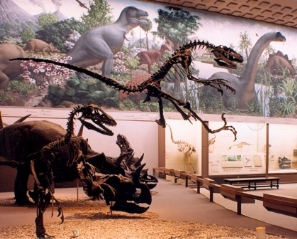 The bigger the dinosaurs and the more interactive the time, the more fun everyone will have. The squeals, smiles and non-stop questions make any family vacation even better.
Here’s the scoop. In the Northeastern states dinosaur encounters come in all sizes from dozens of dinosaur footprints in in Connecticut to towering giants at the American Natural History Museum in NYC. Giant skeletons evoke WOW! Add a few petrified rocks, interesting fossils; maybe a night of stargazing for perspective and your mini family adventure will be complete. I have assembled a short list of the best places in the Northeast to create and share your own dinosaur adventure.
Connecticut: New Haven - Step in dinosaur footprints. At the Peabody Museum of Natural History on the campus of Yale University dinosaurs are part of the fabric of active learning. From the giant, bronze Torosaurus outside to the Great Hall of Dinosaurs and the annual Paleo-Knowledge Bowl to be held each November, dinosaurs remain important. View the world’s largest mounted skeleton - an Apatosaurus; see Rudolph Zallinger’s famous mural The Age of Reptiles and A composite slab of fossil dinosaur footprints. The Discovery Room on site is loaded with engaging activities including a chance for kids to walk in dinosaur footprints. Bonus Points: Highlights Tours of the Museum are offered at no extra charge every Saturday and Sunday. Wait for it! Mark your calendar. Each February the museum presents Dinosaur Days - annual celebration of paleontology hands-on activities for the whole family, a fossil dig, and fossil touch table. (170 Whitney Avenue New Haven, CT 06520-8118. (203) 432-5050 or www.peabody.yale.edu)
Connecticut: Rocky Hill - Cast a track of your own. Dinosaur State Park is the location of one of the largest collection dinosaur track sites in the world. Beneath the geodesic dome, is an exceptional display of early Jurassic fossil tracks that were made nearly 200 million years ago. See a life-size model of a Dilophasaurus and listen to a sound simulation of a full-size Parasaurolophus crest. The discovery room has been updated and staff members are available to will answer questions about the tracks and discuss what Connecticut was like in the early Jurassic period. Bonus Points: Interactive programs are scheduled throughout the summer months including a chance to discuss dinosaurs with Bill Nye. Wait for it! From May through October it is possible to make an Eubrontes track casting onsite. The perfect “show & tell” WOW! for back to school. (400 West Street, Rocky Hill, Connecticut USA 06067. (860) 529-8423 or www.dinosaurstatepark.org) 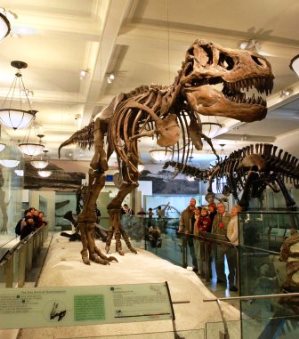
New York: NYC - See the biggest dinosaur collection ever. The American Museum of Natural History is home to one of the greatest fossil collections in the world including dinosaur fossils. The dinosaur connection includes three dinosaur halls and copious displays of mounted dinosaur skeletons. Most popular Tyrannosaurus rex, Stegosaurus, Apatosaurus, Baraosaurus, and Allosaurus. The sheer size of the museum can be overwhelming so to be helpful the museum staff has organized a Dino Tour route. Bonus Points: The museum supports interactive learning through its OLogy connections. Not surprising one of the choices is Paleontology – The Big Dig, a useful link to information, hands-on activities, and games. Wait for it! Even before going to the museum it may be useful to watch the video series "Dinosaurs Explained," in which museum paleontologists Mark Norell, Michael Novacek and Lowell Dingus answer the most frequently asked questions about dinosaurs. (Central Park West at 79th Street, New York, NY 10024. (212) 769-5100, 769-5079 or www.amnh.org )
Massachusetts: Boston - Create a Ctretaceous adventure. The Museum of Science is science heaven for families with oodles of ways to combine fun with interactive experiences. It is home to a 65-million-year-old fossil - one of only four nearly complete Triceratops specimens in the world. Through fossils and life-size replicas visitors can learn how paleontologists verify theories about the life and times of dinosaurs. View fossil clues including bones, footprints, and even dinosaur dung. At the "Who's in the Family?" mural, see what separates dinosaurs from other ancient and modern animals. Examine "bone dictionaries" to explore mystery skeletons; play with scale models of Coelophysis. Bonus Points: Plan to visit the museum on Friday and stay on for “Astronomy after Hours” – a free seasonal program which runs from the first Friday in March to the last Friday before Thanksgiving. (1 Science Park, Boston, MA 02114. (617) 723-2500 or www.mos.org/exhibits)
Researched and compiled by Nancy Nelson-Duac, FTF Editor. Images provided by Peabody Museum with photo credit to Bill Sacco and the American Museum of Natural History with photo credit to ©AMNH\C. Chesek. Updated copyright 2014.
|